 Rangoexchange
 combines DEX liquidity and bridges for same-chain and cross-chain swaps
Rangoexchange finds token swap routes through decentralized exchanges and bridges, covering exchanges within one blockchain and across compatible networks. The service brings available liquidity into one routing interface, helping compare how a swap changes the asset, its network or both. Its app provides a wallet-connected swap interface. An API, JavaScript software development kit (SDK) and embeddable widget also bring the swap service into other applications. A viable route needs compatible assets, sufficient liquidity and providers that support its direction. Expected output, gas, provider fees and required wallet actions shape the choice.
DEX liquidity and bridges contribute different parts of a swap
A decentralized exchange (DEX) supplies on-chain token exchange, while a bridge provides a connection between networks. The aggregator combines compatible providers into available paths. A cross-chain route may include a source swap, a bridge or liquidity-transfer step and a destination swap. Each component contributes a specific operation; their combination connects the starting asset with the requested destination. Message passing can coordinate actions across networks when the selected route uses that mechanism. The selected assets and provider coverage determine which components are needed.
The app and integrations provide different entry points
The standalone app offers direct route comparison through a connected wallet, while integrations bring swap functionality into another product’s interface. Pair directories and directional token-pair views help identify a starting combination before requesting a live quote. A pair listing doesn’t reserve liquidity or a price. The API, SDK and widget address different integration tasks, so the choice concerns how much of the surrounding interface the application needs to build.
API and JavaScript SDK
The API exposes swap services to application code. The JavaScript SDK provides a way to integrate those services in a JavaScript application.
Direct API integration
An application programming interface (API) lets a product request routes and prepare the transactions that a selected swap requires. The integration supplies the asset and network choices that define the request. Its available routes reflect those choices and any supported configuration filters. The interface that hosts the integration must present the relevant quote and authorization details; API access doesn’t itself authorize spending from a connected wallet.
JavaScript SDK integration
The JavaScript SDK packages access to the swap API for a decentralized application (dApp). That allows the application to incorporate swap requests into its own interaction flow. The SDK provides the code integration; the application supplies the surrounding product interface. Asset and network compatibility still come from the swap service and the requested route.
Embedded widget
The customizable widget embeds same-chain and cross-chain swap functionality in a website or dApp. It supplies a swap interface that can be adapted to the host product’s appearance. The interactive playground supports interface customization and routing configuration. This approach places the provided interface inside an existing product, reducing the need to build a swap interface from scratch. Its settings and available providers still determine what the displayed swap can offer.
What changes when a swap crosses a blockchain boundary?
A cross-chain swap changes the network that holds the output asset and may change the asset itself, adding provider and destination-network requirements. A same-chain swap exchanges assets on the selected blockchain. Rangoexchange covers both kinds of request, including Ethereum Virtual Machine (EVM) networks such as Ethereum, Arbitrum and Base. Its coverage also includes environments such as Bitcoin, Solana, TRON, Sui and Osmosis. Support for a network doesn’t establish every possible token pair or exchange direction.
The destination needs an address and token version that the receiving wallet or application supports. Native, wrapped and bridged assets can have different integrations even when their symbols look familiar. A compatible source wallet also matters because the input balance belongs to a particular network. The route preview identifies the networks and providers involved. Cross-chain execution can involve additional contract interactions, making those identifiers relevant to both authorization and the intended destination. The decentralized swap service is non-custodial, so wallet control and transaction approval remain with the user. Execution involves the DEX or bridge contracts that the chosen route uses.
Wallet connection exposes relevant addresses and balances. It doesn’t authorize a transfer; required approvals and transaction signatures remain separate authorization decisions.
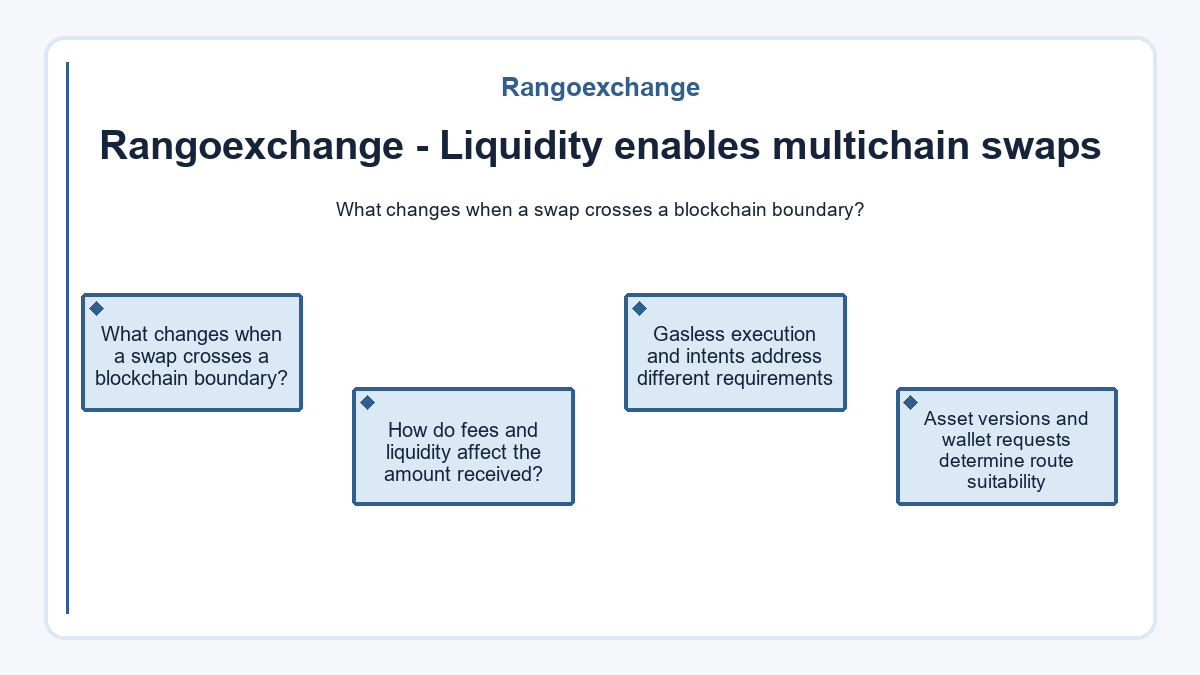
Rangoexchange - Liquidity enables multichain swaps
- What changes when a swap crosses a blockchain boundary?
- How do fees and liquidity affect the amount received?
- Gasless execution and intents address different requirements
- Asset versions and wallet requests determine route suitability
How do fees and liquidity affect the amount received?
Fees and liquidity affect route cost and expected destination output, with the fee-payment method determining which balance covers a charge. The standalone app adds no extra swap fee. Network gas and underlying DEX, bridge or liquidity-provider charges can still apply. API integrations can have protocol or affiliate fees, so the app’s pricing doesn’t establish the cost of every integrated interface. Fee collection may occur in the source wallet, through reduced output or in the destination wallet.
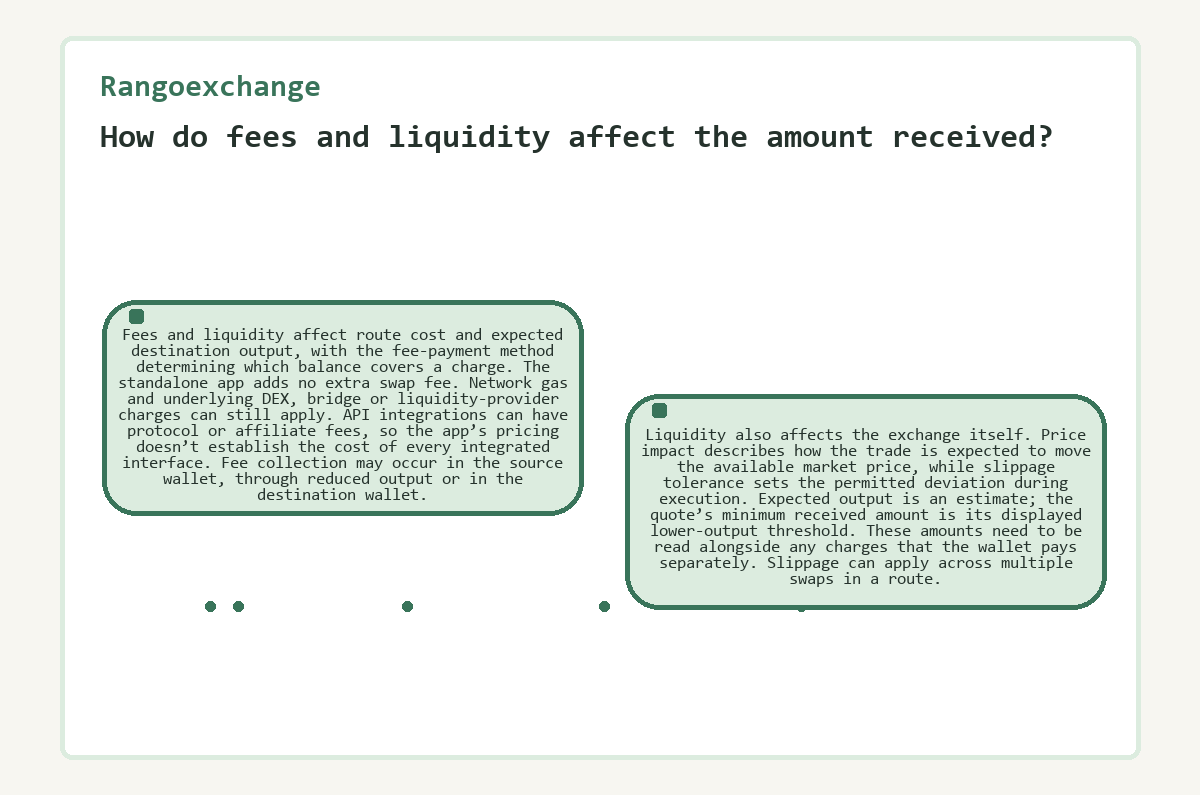
Liquidity also affects the exchange itself. Price impact describes how the trade is expected to move the available market price, while slippage tolerance sets the permitted deviation during execution. Expected output is an estimate; the quote’s minimum received amount is its displayed lower-output threshold. These amounts need to be read alongside any charges that the wallet pays separately.
Slippage can apply across multiple swaps in a route.
Gasless execution and intents address different requirements
Gasless execution lets users swap on supported Solana and EVM routes without holding native gas tokens. With intents, users sign a requested outcome, and the engine auctions it to solvers that fulfill it across networks. The wider product vision includes payment, lending, staking, limit orders, dollar-cost averaging and NFT purchases through intents, alongside AI-assisted execution. Those ambitions shouldn’t be read as active options in every swap interface. An ordinary wallet-signed route retains its stated gas and approval requirements unless the selected execution method changes them.
Asset versions and wallet requests determine route suitability
A suitable route must match the intended asset and destination as well as the available source balance. Output alone can’t resolve a mismatch between networks or token contracts. The wallet request needs to agree with the route preview before signing. Unexpected recipient, asset or contract details are a reason to defer execution. Seed phrases and private keys aren’t inputs to the swap interface or a support form; wallet signing provides the authorization that the route needs.
Decide whether the displayed route fits the transfer
The preview connects the chosen input with a possible destination output. That connection is useful only while its asset, network and execution conditions match the intended transfer.
- Match the input token and source network to the balance that the connected wallet holds.
- Confirm that the recipient address and output token version work on the selected destination network.
- Read expected output and minimum received alongside the gas and provider charges shown for the route.
- Retain native gas tokens wherever the route requires you to pay for transactions or approvals, including intermediate or destination networks on multi-step routes.
- Match each wallet request’s relevant token, contract and network details to the route preview before signing. Check the approval spender or transfer recipient as applicable.
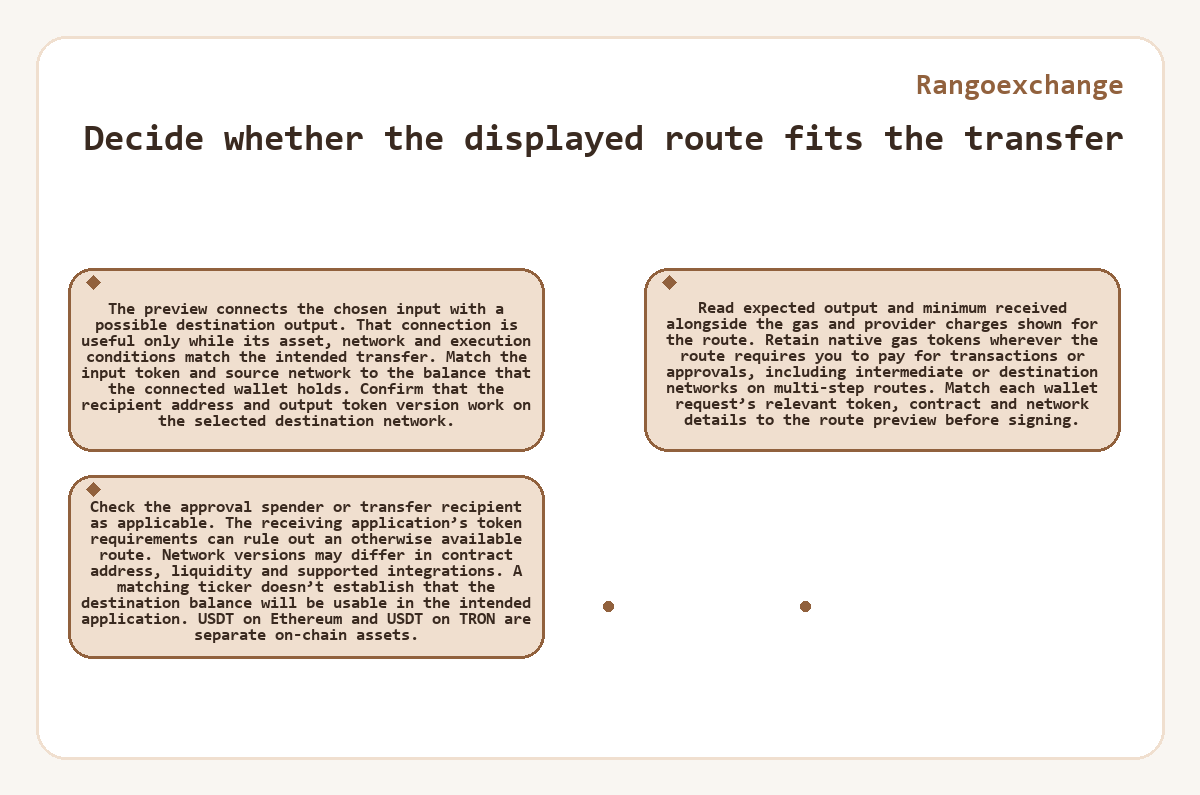
The receiving application’s token requirements can rule out an otherwise available route. Network versions may differ in contract address, liquidity and supported integrations. A matching ticker doesn’t establish that the destination balance will be usable in the intended application. USDT on Ethereum and USDT on TRON are separate on-chain assets.
Key questions about Rangoexchange
Does a token-pair chart show the amount I’ll receive?
A token-pair chart shows market context, not an executable swap quote. The route quote uses the selected networks, amount and available liquidity, alongside relevant fees and slippage settings. Recent price movement can reveal unusual market conditions. A chart price doesn’t reserve an exchange rate or establish the final received amount.
What happens if a swap quote expires?
An expired swap quote needs to be refreshed before confirmation. The replacement quote may contain different expected output, fees or providers, so the refreshed details become the relevant preview for any wallet request. The earlier quote doesn’t preserve its original execution terms.
How long does a cross-chain swap take?
A cross-chain swap’s duration depends on network congestion, chain finality, provider liquidity and the route’s execution steps. Displayed completion times are estimates. Follow a transfer that hasn’t completed through its status information or relevant block explorers before submitting the transfer again.
Why can finding a route take longer than expected?
Route discovery relies on responses from pricing and liquidity sources, so a slow provider can delay the quote. The routing engine may retry requests or wait for a provider response. Quote preparation time is separate from the time needed to execute a signed swap.
Is identity verification required for every Rangoexchange route?
Rangoexchange’s decentralized swap interface doesn’t require know-your-customer (KYC) identity checks. An integration using the Basic API can enable centralized swap providers, which require user IP data for compliance screening. Those providers may hold funds for identity verification if their compliance screening flags a wallet as risky. SWFT can also require KYC for large transactions.
Must each component of a route use a separate transaction?
Several route components can be combined into one transaction when the supported contracts and messaging mechanisms allow it. A swap-and-bridge combination therefore doesn’t automatically mean separate wallet transactions. The actual route preview and wallet requests determine the execution requirements for that route.
Which credentials does an API integration need?
API requests need an API key appropriate to the integration’s environment. The public test key is for development and has restricted rate limits; it shouldn’t be used in production. Production integrations need their own key. Limits apply per IP address and key.
Can a token pair be missing from the directory and still have a route?
A pair that isn’t prominently listed can still be entered as a custom swap when a route is available. The directory surfaces popular combinations. Compatibility, the entered amount and available providers determine whether a custom request produces a quote; the listing’s absence doesn’t settle that question.