 Rangoexchange
Rangoexchange approvals authorize token spending for routes that require an allowance
Rangoexchange requires token approval when a selected route lacks sufficient permission to spend the wallet’s input token. That approval gives a specified contract access within a spending allowance. In a conventional approval flow, signing the main swap transaction authorizes route execution after any required approval is confirmed. Connecting the wallet alone doesn’t grant token spending permission. A signature’s meaning comes from the request’s action and scope, so match the token, contract and amount with the route before accepting it.
Key takeaway: A confirmed token approval permits the next swap step only when its allowance covers the amount required by the selected route.
The wallet, token contract and route have different jobs
Where a route uses a token allowance, the wallet authorizes approval and the token contract records the spender’s permission once the approval takes effect on-chain. The spender can then transfer approved input tokens for the route’s exchange or transfer operation. A decentralized exchange uses tokens within a network, while a bridge or liquidity-transfer provider moves value between networks when the route includes that action. Different providers can introduce different contract interactions, which explains why wallet requests vary with the selected path. An application that embeds the swap service also prepares requests for the connected wallet. The wallet authorizes the account’s actions; the selected contracts execute the permitted operations.
The connected address identifies the account involved and makes its address and balance information available to the interface. Connection doesn’t itself move tokens. The wallet presents the requested authorization for acceptance or rejection. Self-custody still allows the selected contracts to use the token permission that an account holder grants.
The request type determines what a signature authorizes
Signing a token approval authorizes a change to spending permission, while signing a swap transaction authorizes its specified operations. A confirmation label alone doesn’t identify that difference, so read the operation that the wallet describes and the contract involved. Signing authorizes the supplied data; submission sends it to the network. A generated request or transaction hash doesn’t establish successful execution. Network confirmation and the appropriate transaction status establish what actually happened.
Token allowances specify a spender and an amount
Where an EVM route uses ERC-20 approvals, permission concerns a particular token contract on a particular chain. An ERC-20 approval authorizes a specified spender to use up to the approved amount of a token.
Permission belongs to the authorizing account, token contract and spender. Choosing another contract changes the allowance that is relevant. An approval amount describes authorized input-token access; it doesn’t describe output tokens or promise a conversion rate.
The standard’s approve operation sets an allowance and overwrites the existing value for the same spender. It doesn’t add a new grant onto the previous total. The spender can use permission over multiple transfers, subject to the token’s implementation.
A proposed allowance can exceed the wallet’s current balance and may also cover tokens added later. An effectively unlimited grant therefore exposes more of that token to the spender. It still concerns the specified token; it isn’t permission for every asset in the account.
Route-specific contracts determine who receives permission
If a route uses a dynamically generated approval contract, a previously used spender address doesn’t establish the required permission. Some bridge integrations generate that address through their API from the selected route. The approval data supplied for the current request identifies the intended transaction. An integration that substitutes a memorized address can authorize the wrong contract.
For a conventional ERC-20 approval, the transaction calls the token contract and specifies the spender within the approval data. The address receiving the transaction and the contract receiving spending permission have different roles; neither automatically identifies the final recipient of a cross-chain swap. Inspecting only one address can miss that distinction. Keep the token contract and source network together when interpreting these fields, since an identical ticker on another chain can identify a different asset.
Adequate approval allows the main swap signature
Where transaction creation returns approval data, the documented Basic API flow confirms adequate permission before requesting the main swap signature. An EVM response can carry
approveTo
and
approveData
alongside the main transaction data. Non-null approval data in these fields supplies the transaction that the integration needs to prepare.
After submitting that approval, the integration checks its network status and the permission available for the request. In this approval flow, the permission check passes only when the recorded allowance covers the required amount.
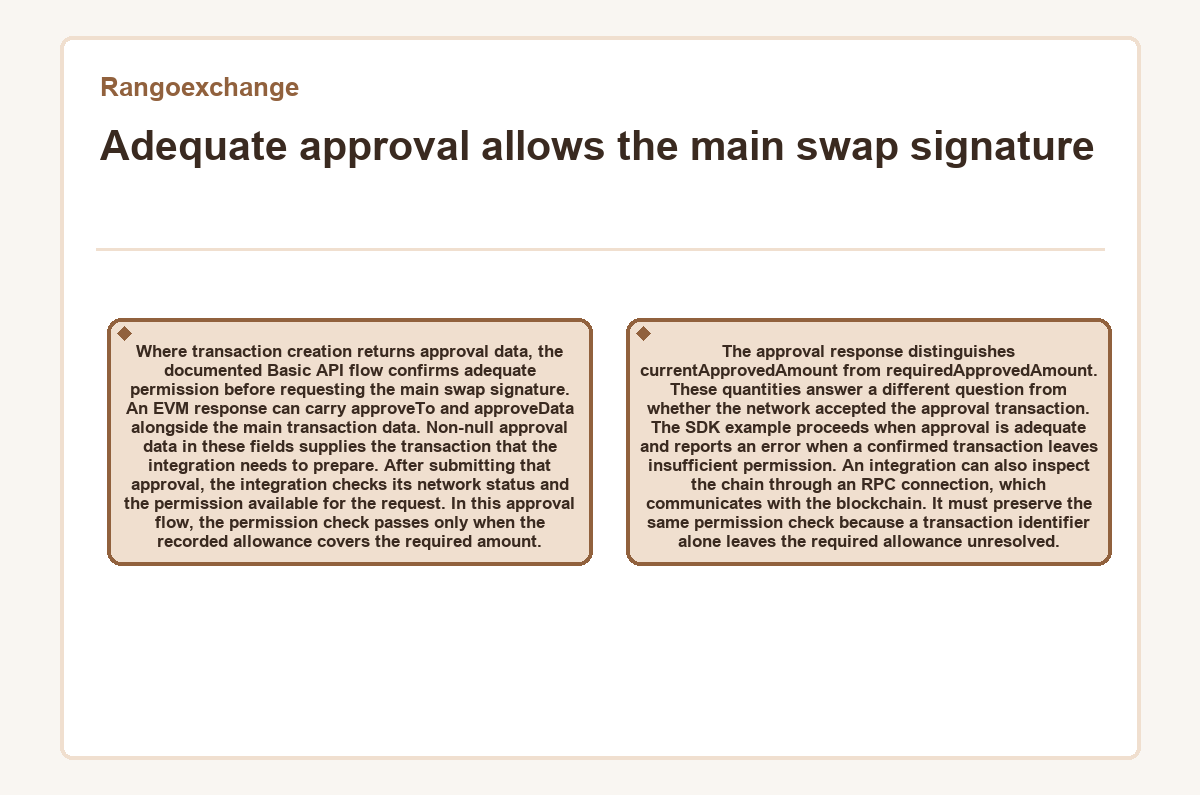
The approval response distinguishes
currentApprovedAmount
from
requiredApprovedAmount
. These quantities answer a different question from whether the network accepted the approval transaction. The SDK example proceeds when approval is adequate and reports an error when a confirmed transaction leaves insufficient permission.
An integration can also inspect the chain through an RPC connection, which communicates with the blockchain. It must preserve the same permission check because a transaction identifier alone leaves the required allowance unresolved.
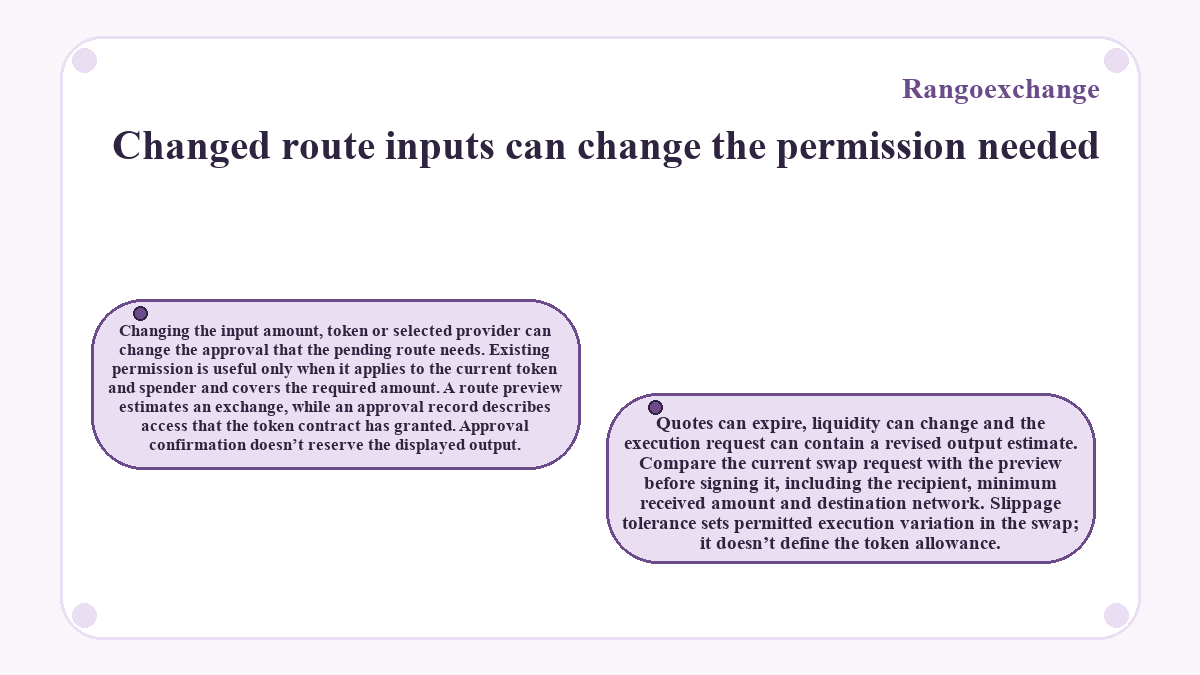
Changed route inputs can change the permission needed
Changing the input amount, token or selected provider can change the approval that the pending route needs. Existing permission is useful only when it applies to the current token and spender and covers the required amount. A route preview estimates an exchange, while an approval record describes access that the token contract has granted.
Approval confirmation doesn’t reserve the displayed output. Quotes can expire, liquidity can change and the execution request can contain a revised output estimate. Compare the current swap request with the preview before signing it, including the recipient, minimum received amount and destination network. Slippage tolerance sets permitted execution variation in the swap; it doesn’t define the token allowance.
Why can an approval succeed while the swap remains blocked?
An approval can succeed while leaving too little permission for the swap when the recorded allowance is below the route’s requirement.
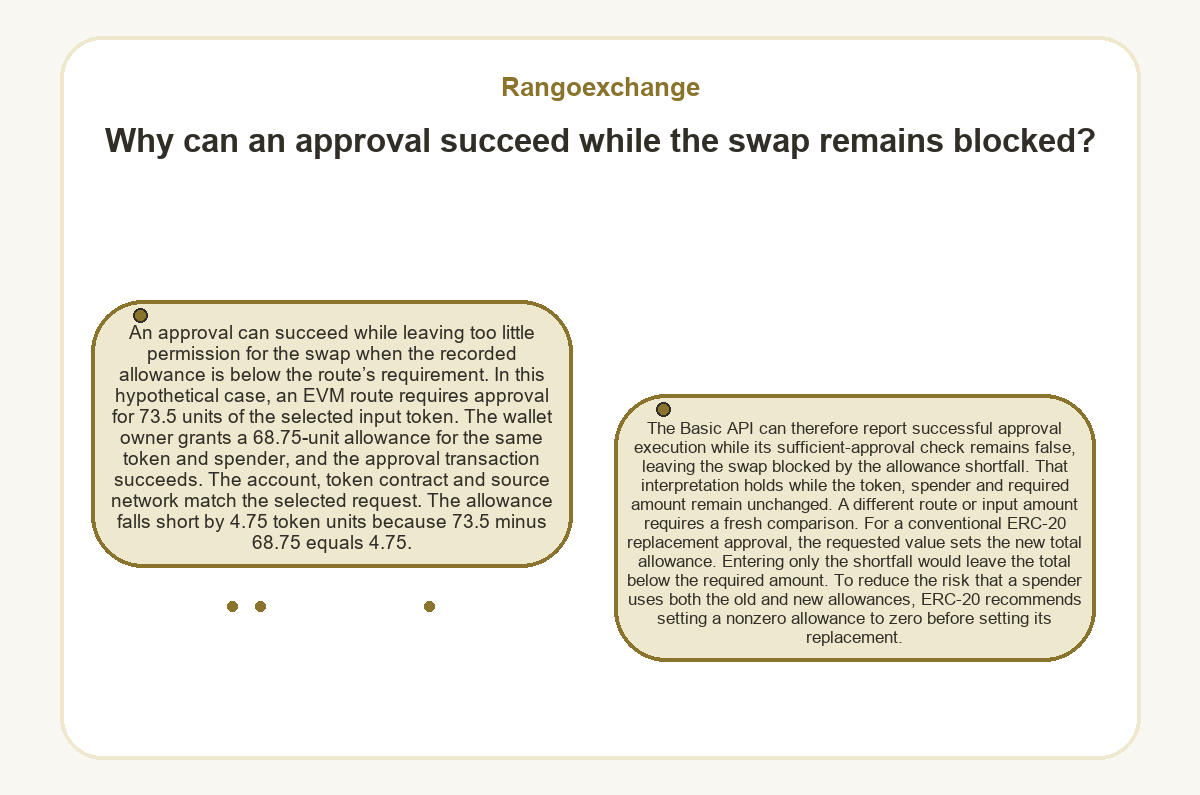
In this hypothetical case, an EVM route requires approval for 73.5 units of the selected input token. The wallet owner grants a 68.75-unit allowance for the same token and spender, and the approval transaction succeeds. The account, token contract and source network match the selected request.
The allowance falls short by 4.75 token units because 73.5 minus 68.75 equals 4.75. The Basic API can therefore report successful approval execution while its sufficient-approval check remains false, leaving the swap blocked by the allowance shortfall.
That interpretation holds while the token, spender and required amount remain unchanged. A different route or input amount requires a fresh comparison. For a conventional ERC-20 replacement approval, the requested value sets the new total allowance. Entering only the shortfall would leave the total below the required amount. To reduce the risk that a spender uses both the old and new allowances, ERC-20 recommends setting a nonzero allowance to zero before setting its replacement.
The main signature commits the selected swap instructions
Once any required approval is adequate, the main swap signature authorizes the specific execution request that the wallet displays. The transaction data determines the contract call and any native currency sent with it. The selected route defines the intended input, destination token and network, with output subject to the quoted execution conditions.
The final recipient needs its own check because permission to a spender doesn’t establish where swap output goes. Match the recipient address, token contracts and networks with the intended transfer. Inspect minimum output and surfaced provider interactions, and reject a request when an identifier differs from the preview or the operation is unexpected.
Submission of the main transaction begins a different status check from approval confirmation. Cross-chain execution can require waiting for destination progress after the source action. Congestion, finality and provider liquidity can delay completion. Monitor swap status before repeating a transfer simply because the destination balance hasn’t updated.
Networks and native assets change the approval requirement
An ERC-20 allowance explains the EVM token case, while other networks can present different transaction formats and authorization rules. The Basic API documents approval handling for EVM networks, TRON and Starknet when it returns approval data. Its response format determines the transaction that the integration passes to the wallet without establishing an approval requirement for every asset on those networks.
Native ETH doesn’t use an ERC-20 spending allowance. An execution transaction can transfer native currency directly, so its value field needs attention. Gas funding is another requirement in conventional on-chain approval flows. The wallet needs the applicable network fee asset for approval and any later transaction. An input-token balance can cover gas only when that token is also the fee asset and sufficient funds remain.
Signed messages follow the token’s supported permission rules
When a token implements signed approvals, a message signature can carry spending authority without the owner sending a conventional approval transaction. ERC-2612 defines a permit mechanism that updates an allowance through a signed message. Its fields include the owner, spender, value and deadline. Someone must submit that permit on-chain for the allowance change to take effect.
The deadline limits acceptance of the permit; it doesn’t automatically expire the allowance that the permit creates. The token and selected execution flow must support this mechanism for a permit to apply. Read the actual wallet request to distinguish signed token permission from other messages; an ordinary message request doesn’t necessarily grant token access.
A gasless execution label concerns how a supported flow handles network costs. Read any requested spending permission separately from fee payment because the absence of a gas charge at signing doesn’t make an authorization harmless.
Remaining allowances differ from connected wallet access
After a conventional token approval takes effect, remaining allowance can survive completion of the intended swap. The token contract tracks permission separately from the browser’s connection to the wallet. Disconnecting a wallet from an application doesn’t revoke its existing token allowances. Closing the interface also doesn’t rewrite the token contract’s state.
Revocation changes spending permission on-chain. For a conventional ERC-20 allowance, setting the relevant spender’s allowance to zero removes that remaining authorization. Confirm that the update applies to the correct account, token contract, spender and network. It doesn’t reverse a transfer that already occurred, and a later swap that needs this spender can require approval again.
Revocation normally needs network gas and transaction confirmation, while disconnecting changes the app connection without updating the allowance.
Common questions, answered
-
Does an existing Rangoexchange allowance carry over to a different wallet account?
- An existing allowance doesn’t carry over to a different authorizing account. Token permission belongs to the account that granted it, for the specified token contract and spender. Switching accounts changes which allowance is relevant even when the selected token and route look identical. The integration must evaluate permission for the account that will supply the input tokens.
-
Which amount matters if an approval screen displays raw token units?
- Compare the current allowance and required approval in the same token units. Contract quantities may use integer base units, while displayed token quantities account for the token’s decimal setting. A different scale can make a comparison misleading. Also keep the approval amount separate from the output estimate and gas cost, which describe different quantities.
-
Will declining the swap transaction cancel an earlier token approval?
- Declining a conventional swap transaction doesn’t cancel an approval that has already taken effect on-chain. The rejected request leaves that transaction unexecuted, while the token contract retains the permission granted earlier. Remaining access follows the allowance’s rules until it is consumed or changed. A wallet rejection and an on-chain revocation are different actions.
-
Must I provide a seed phrase to resolve a Rangoexchange approval error?
- An approval error doesn’t require sharing a seed phrase or private key. Those credentials control the wallet and aren’t approval-status information. The relevant details are the affected transaction, token permission and selected route. Entering wallet secrets into a swap interface, pop-up or support form doesn’t confirm or correct an allowance.
-
Can a source-network token approval authorize spending on the destination network?
- A conventional source-network allowance doesn’t grant destination-network token permission. It belongs to the token contract and authorizing account on the chain where it was recorded. A cross-chain route may coordinate further actions through its providers, but that doesn’t copy the allowance across networks. Any destination-side authorization follows the mechanism used by that part of the route.
-
How much native currency is needed to change an allowance?
- A conventional EVM allowance update needs enough native currency to cover the transaction’s network fee. The gas requirement and network fee settings determine that amount. It isn’t a fixed Rangoexchange approval charge. The allowance itself describes token access, not gas funding. Other supported authorization or fee-payment arrangements can handle payment differently.
-
What does a successful transaction-creation response establish before signing?
- A successful transaction-creation response establishes that the API prepared transaction data. It doesn’t establish wallet authorization, submission or network execution. The Main API’s EVM, TRON and Starknet transaction formats include an isApprovalTx flag to identify approval requests. Interpret the prepared request before signing; a generated payload isn’t a completed swap.