 Rangoexchange
Rangoexchange fees change with the swap and bridge operations in a route
Rangoexchange fees vary with network gas, provider charges and any applicable service or integration fees in the selected route. Some charges already reduce the quoted output; others need a separate wallet balance. Same-chain swaps and cross-chain exchanges involve different operations, so compare the fee payment assets, expected output and required approvals for the exact exchange.
A token exchange within one network can have a different cost structure from a transfer involving a bridge. Keeping payment amounts separate from output estimates makes both easier to interpret, especially when the wallet shows another figure before signing.
The short version: Fees already reflected in quoted output should count only once when comparing a route’s value after separately funded gas.
Adding route charges without counting them twice
A comparable fee total adds applicable service charges, provider fees and network fees once, after converting them into the same currency. Rangoexchange brings together decentralized exchanges (DEXs), bridges and liquidity providers, so the selected operations determine which charges apply. A fee that a provider includes in its exchange calculation can already affect the output estimate. Separately funded gas still needs its own balance. Subtracting every displayed charge from an already reduced output would count some costs twice.
Expected output describes the quoted destination amount. It doesn’t include every separately paid expense or prove that execution has finished.
Keep the fee breakdown and the output amount together when comparing routes. One describes charges; the other describes the asset expected at the destination. Price impact also changes exchange value, although it isn’t a service fee. Combining these meanings into one unexplained percentage makes it difficult to identify what caused a difference.
Fee amounts, token units and network balances
Every fee amount needs a payment token and network before it can describe a usable wallet requirement. Gas units measure computation, while a token amount describes payment. They’re different units. Likewise, a fee valued in dollars isn’t a request to pay dollars. For a separately paid wallet fee, the wallet still needs the relevant on-chain asset. When an API reports raw token amounts, the token’s decimals determine their displayed quantity; those raw integers aren’t automatically whole tokens.
In the Basic API, a fee marked
FROM_SOURCE_WALLET
requires funding from the source wallet. A fee marked
DECREASE_FROM_OUTPUT
already affects estimated output. Fees marked FROM_DESTINATION_WALLET are paid from the destination wallet, typically when a bridge requires a claim transaction. A fee’s payment location doesn’t make two fee amounts directly comparable when they use different tokens. Convert their values onto a consistent basis before interpreting a total.
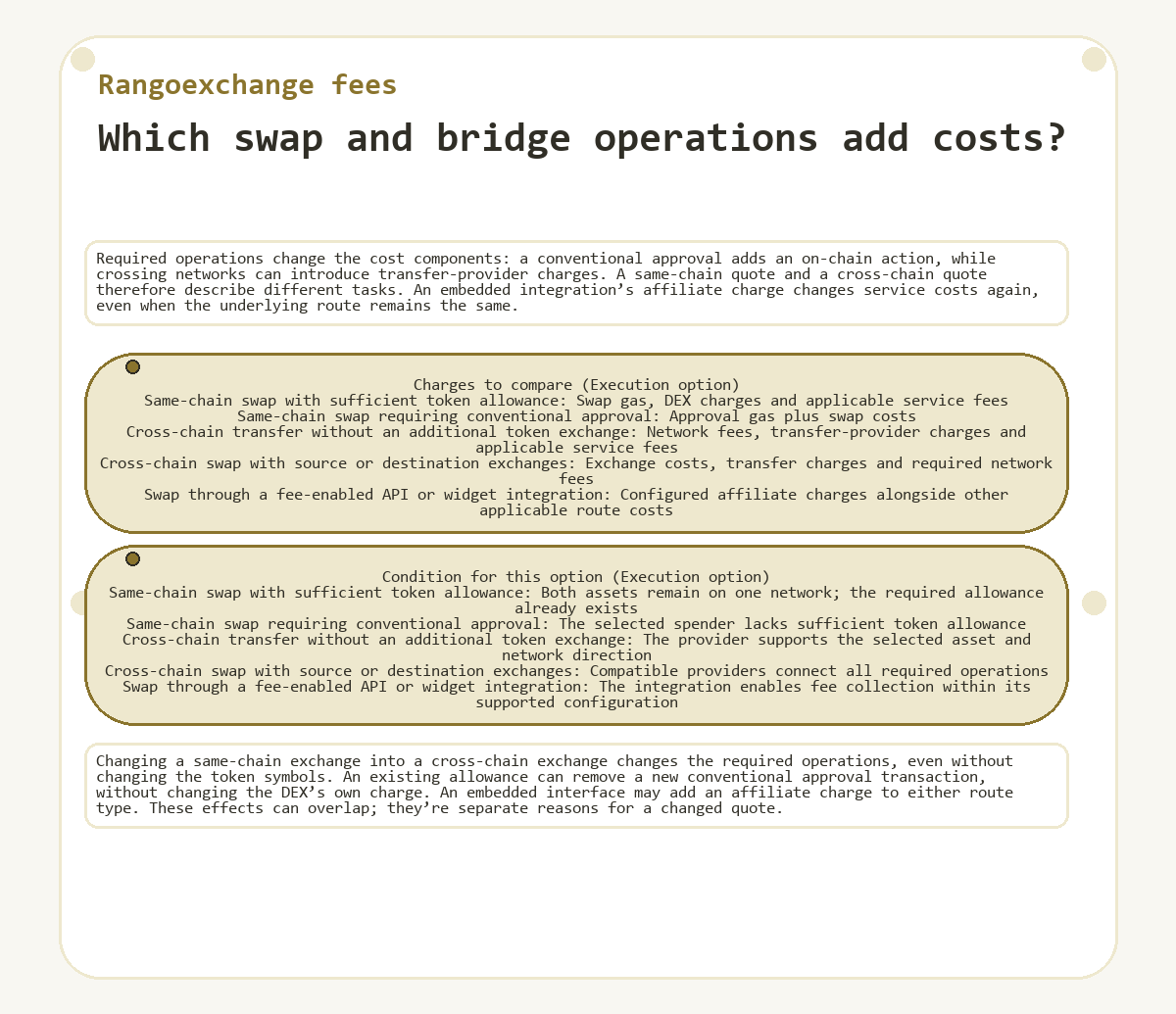
Which swap and bridge operations add costs?
Required operations change the cost components: a conventional approval adds an on-chain action, while crossing networks can introduce transfer-provider charges. A same-chain quote and a cross-chain quote therefore describe different tasks. An embedded integration’s affiliate charge changes service costs again, even when the underlying route remains the same.
Which swap and bridge operations add costs?
- Charges to compare (Execution option) Same-chain swap with sufficient token allowance: Swap gas, DEX charges and applicable service fees Same-chain swap requiring conventional approval: Approval gas plus swap costs Cross-chain transfer without an additional token exchange: Network fees, transfer-provider charges and applicable service fees Cross-chain swap with source or destination exchanges: Exchange costs, transfer charges and required network fees Swap through a fee-enabled API or widget integration: Configured affiliate charges alongside other applicable route costs
- Condition for this option (Execution option) Same-chain swap with sufficient token allowance: Both assets remain on one network; the required allowance already exists Same-chain swap requiring conventional approval: The selected spender lacks sufficient token allowance Cross-chain transfer without an additional token exchange: The provider supports the selected asset and network direction Cross-chain swap with source or destination exchanges: Compatible providers connect all required operations Swap through a fee-enabled API or widget integration: The integration enables fee collection within its supported configuration
| Execution option | Charges to compare | Condition for this option |
|---|---|---|
| Same-chain swap with sufficient token allowance | Swap gas, DEX charges and applicable service fees | Both assets remain on one network; the required allowance already exists |
| Same-chain swap requiring conventional approval | Approval gas plus swap costs | The selected spender lacks sufficient token allowance |
| Cross-chain transfer without an additional token exchange | Network fees, transfer-provider charges and applicable service fees | The provider supports the selected asset and network direction |
| Cross-chain swap with source or destination exchanges | Exchange costs, transfer charges and required network fees | Compatible providers connect all required operations |
| Swap through a fee-enabled API or widget integration | Configured affiliate charges alongside other applicable route costs | The integration enables fee collection within its supported configuration |
Changing a same-chain exchange into a cross-chain exchange changes the required operations, even without changing the token symbols. An existing allowance can remove a new conventional approval transaction, without changing the DEX’s own charge. An embedded interface may add an affiliate charge to either route type. These effects can overlap; they’re separate reasons for a changed quote.
Service charges inside an embedded swap
An API or widget integration can configure an affiliate charge, which adds a cost associated with that interface. This explains why the route’s provider costs alone may not describe its full service charges. Fee collection also has network and provider conditions, so a configuration doesn’t establish universal availability.
The Main API affiliate configuration allows an input-based fee of up to 3%. Its documented default is 0.1%, equivalent to 10 basis points. These settings belong to that affiliate configuration; they aren’t a universal total for swaps made through every interface.
The affiliate program also specifies a Rango share of 15 basis points alongside the configured affiliate amount. Commercial fee-sharing arrangements can affect that share. Keep the affiliate charge, Rango’s share and underlying provider costs distinct when interpreting the quote, without assuming that a service label contains them all.
Rango’s own swap app is documented as charging no additional app fee. Network and provider charges can still apply; the API and widget charges above have a separate integration scope.
Gas limits and actual execution charges
A gas limit sets an execution ceiling, while gas used determines the computational work charged for an Ethereum transaction.
An Ethereum transaction’s execution gas fee equals gas used multiplied by its effective price per gas unit. A wallet’s maximum-cost display can therefore differ from the expected fee. The gas limit describes permitted consumption. It doesn’t establish that the transaction will consume every available unit.
Rango’s transaction creation can apply safety factors to gas limits because complex execution may need more headroom than a net estimate suggests. Gas refunds can lower net consumption without lowering the gas limit needed to complete execution. Reducing the limit to match that net estimate can cause an otherwise executable transaction to run out of gas.
Compare the requested limit with the fee estimate before signing. After execution, the receipt establishes consumption and the effective gas price.
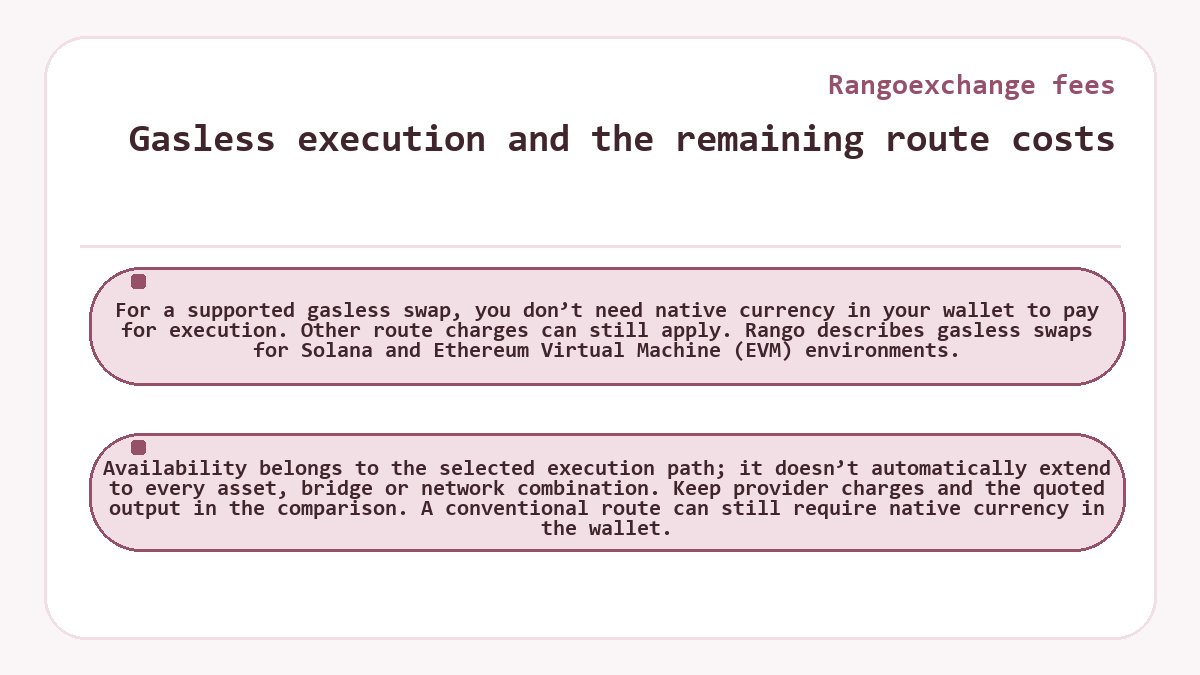
Gasless execution and the remaining route costs
For a supported gasless swap, you don’t need native currency in your wallet to pay for execution. Other route charges can still apply. Rango describes gasless swaps for Solana and Ethereum Virtual Machine (EVM) environments. Availability belongs to the selected execution path; it doesn’t automatically extend to every asset, bridge or network combination. Keep provider charges and the quoted output in the comparison. A conventional route can still require native currency in the wallet.
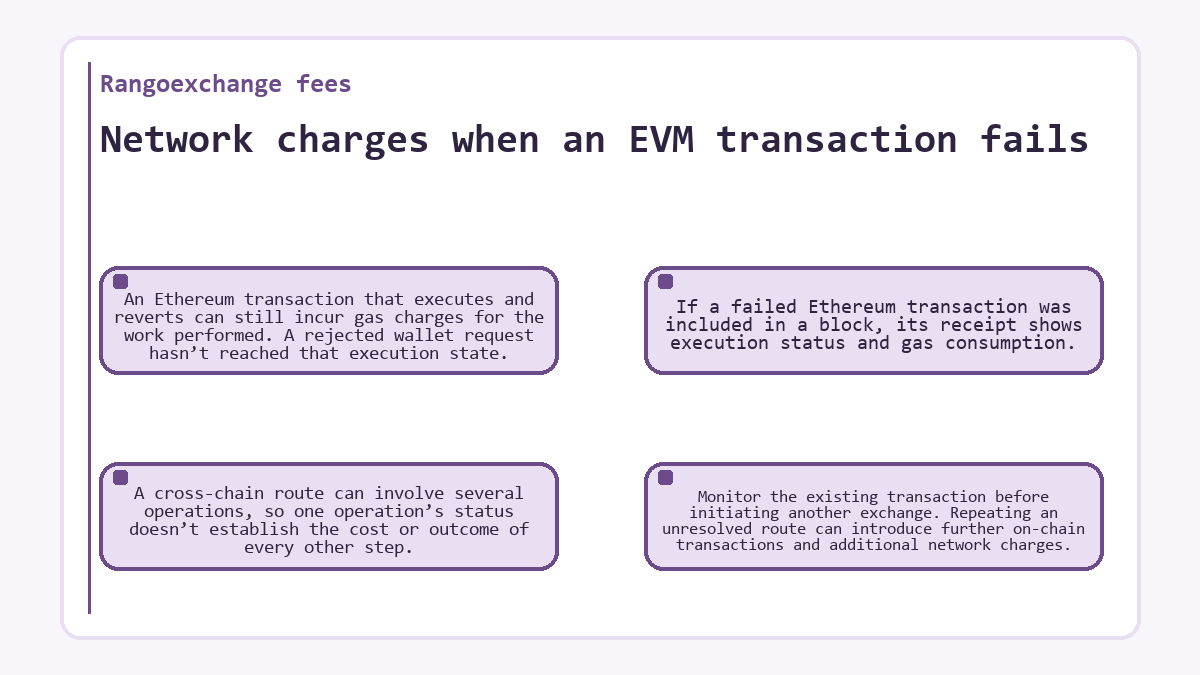
Network charges when an EVM transaction fails
An Ethereum transaction that executes and reverts can still incur gas charges for the work performed. A rejected wallet request hasn’t reached that execution state.
If a failed Ethereum transaction was included in a block, its receipt shows execution status and gas consumption. A cross-chain route can involve several operations, so one operation’s status doesn’t establish the cost or outcome of every other step. Monitor the existing transaction before initiating another exchange. Repeating an unresolved route can introduce further on-chain transactions and additional network charges.
Trade size, price impact and slippage tolerance
A larger input can change exchange value through price impact when the order is large relative to available liquidity. Price impact describes the trade’s expected effect on the available price. Slippage tolerance specifies the permitted movement during execution. Raising that tolerance doesn’t lower the fee that a pool charges; it changes the acceptable execution range.
Provider fees and network costs also behave differently as the input changes. A percentage-based charge changes with its stated calculation base. Gas reflects transaction work and network pricing, so it doesn’t necessarily scale in proportion to the swapped amount. A multi-step route can contain several exchanges with slippage exposure. Keep the final minimum output alongside the fee total, without treating the tolerance percentage as a billed charge.
Quotes, wallet requests and completed charges
A cost comparison requires the same input amount, token versions and network direction across the available routes. Otherwise, the quotes describe different exchanges. An expired quote needs refreshing before confirmation. Use the route’s fee breakdown to identify payment assets and separately required balances, then match the wallet request to the preview. Differences from the preview need resolving before signing, particularly when a changed provider affects the charges.
Completion time is an estimate. A pending source transaction doesn’t establish that the quoted destination amount has arrived.
The completed exchange provides the received amount, while transaction receipts identify actual network charges. The same pair can need a fresh cost comparison next time because gas, liquidity and available providers change. An alternative with slightly lower quoted output can leave greater net value when its separately paid network costs are lower.
Quick answers about Rangoexchange fees
Does requesting a Rangoexchange fee quote spend any gas?
Requesting a route quote doesn’t itself submit an on-chain transaction. The quote previews output and charges for the requested exchange. Network gas relates to on-chain execution, including a conventional token approval when one is needed.
Are gas refunds and bridge-fee refunds the same thing?
Gas refunds and bridge-fee refunds follow different rules. Unused capacity within an Ethereum transaction’s gas limit isn’t charged as consumed computation. Some bridge fee models return an excess payment when the required fee is lower than the funded amount. That refund depends on the selected bridge’s mechanism; it doesn’t establish a refund for every provider or service charge.
Will disconnecting my wallet refund an approval fee?
Disconnecting a wallet doesn’t refund gas already paid for a confirmed on-chain approval. The approval transaction has performed work on the network, regardless of whether the later swap proceeds. Ending the interface connection doesn’t reverse that transaction or its network charge.
What does a missing USD fee estimate mean?
A missing USD estimate means the quote hasn’t supplied a dollar-denominated fee total. It doesn’t establish a zero fee. Use the available fee amounts and their payment tokens to interpret the charges.
Do referral fees go to the swap’s recipient address?
Referral fees go to the configured affiliate wallet, which has a separate purpose from the swap’s destination address. In a fee-enabled integration, the affiliate configuration determines the fee recipient. The destination address identifies where the exchanged asset should arrive; it doesn’t by itself identify who collects a referral charge.
Can splitting a swap automatically reduce its total fees?
Splitting a swap doesn’t automatically reduce its total cost. Smaller orders may reduce price impact, while additional on-chain transactions introduce further gas charges. Compare the combined charges and output of the proposed exchanges against the unsplit route. A lower price impact alone doesn’t establish a lower overall cost.