 Rangoexchange
 Rangoexchange routing: token and network matching
Rangoexchange routing matches the input asset and source network with a compatible path to the requested output token and destination network. Routes draw on decentralized exchanges (DEXs), bridges and liquidity providers that cover those choices. The selected token version matters because native, wrapped and bridged assets can have different uses. A quote describes a possible path for the specified amount. The selected output version must also work with the wallet or application where it’ll be used.
Key takeaway: A viable route must deliver the exact token version that the receiving wallet or application accepts on the selected destination network.
Match the destination to the token’s next use
Moving an asset to a destination application requires a route that ends with the token version that application accepts on its network. The source selection describes where the input balance exists now. The destination describes where the output belongs after execution. Both choices affect the providers that can connect them. A familiar token symbol on an unsupported network won’t satisfy the destination requirement. The requested direction also matters: the route starts with the asset held and ends with the asset needed.
Native, wrapped and bridged versions can differ in liquidity, application support and redemption pathways. Those differences belong in the token selection. Choosing the destination network alone leaves the asset version unresolved, even when the displayed ticker looks familiar.
Why isn’t a token symbol enough for routing?
A token symbol doesn’t identify its network or contract, so it can’t specify a complete source or destination asset by itself. Rangoexchange represents assets with blockchain, symbol and address properties.
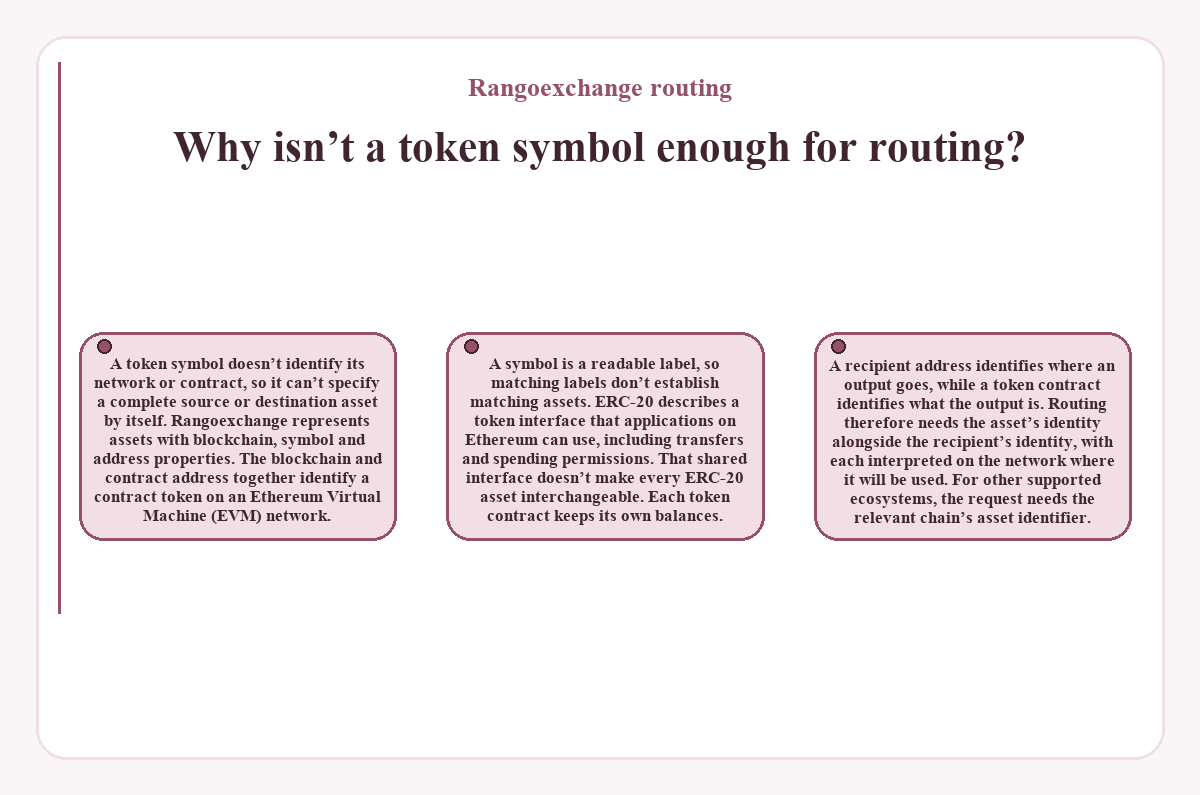
The blockchain and contract address together identify a contract token on an Ethereum Virtual Machine (EVM) network. A symbol is a readable label, so matching labels don’t establish matching assets.
ERC-20 describes a token interface that applications on Ethereum can use, including transfers and spending permissions. That shared interface doesn’t make every ERC-20 asset interchangeable. Each token contract keeps its own balances. A recipient address identifies where an output goes, while a token contract identifies what the output is. Routing therefore needs the asset’s identity alongside the recipient’s identity, with each interpreted on the network where it will be used.
For other supported ecosystems, the request needs the relevant chain’s asset identifier.
Compatible handoffs between exchanges and bridges
A path can join several providers only when the output of each component works as the input of the next component. A source-network DEX exchanges the starting asset where it’s held. A bridge or liquidity-transfer provider handles the network change when the request requires one. A destination-network exchange can then produce the requested output asset. The routing engine combines available providers into compatible paths and compares them by swap output, fees and user experience. Exchange components require liquidity in the relevant assets; transfer components must support the chosen network connection.
The displayed route can contain intermediate assets that differ from the asset ultimately requested. Those assets connect operations within the path. The preview identifies the final output separately, including its token version and destination network.
Choose whether to change the asset, the network or both
Whether a route needs an exchange, a transfer or both follows from the difference between its starting and destination assets. A same-chain exchange changes the token on one blockchain. A transfer to another blockchain changes where value is available. Combining those operations connects different assets across networks, if compatible providers cover the complete path.
Rangoexchange routing - Token and network matching
- Why isn’t a token symbol enough for routing?
- Compatible handoffs between exchanges and bridges
- Choose whether to change the asset, the network or both
- Read the quote in the output token’s units
| Path | Change involved | Destination requirement |
|---|---|---|
| Same-chain token exchange | The token changes on the selected blockchain. | The receiving wallet or application supports the exact output token on that network. |
| Bridge or liquidity transfer | The network changes; the asset representation may change. | The receiving network supports the asset version required by the wallet or application. |
| Cross-chain token exchange | The asset and network change through compatible exchange and transfer components. | The path ends with the requested token version on the requested network. |
| The destination asset version, selected direction and provider coverage determine which paths can connect the requested endpoints. | ||
A transfer can retain the same ticker while producing a different on-chain representation. USDT on Ethereum and USDT on TRON are separate assets despite sharing their symbol. The token and receiving network must match the intended use in either case. These operation types describe what the path accomplishes; they don’t specify a universal transaction count.
Read the quote in the output token’s units
Quoted output estimates what the selected path would deliver for the requested amount and destination asset under its quoted conditions. The minimum received amount gives the lower output boundary associated with the quote’s slippage conditions. Both figures use output-token units. The input balance belongs to the source asset, while the quoted output belongs to the destination asset. Matching tickers don’t merge balances held on different networks.
Increasing the input amount changes the liquidity demand of the route. Price impact can rise when the amount grows relative to available liquidity, so scaling an earlier quote isn’t reliable.
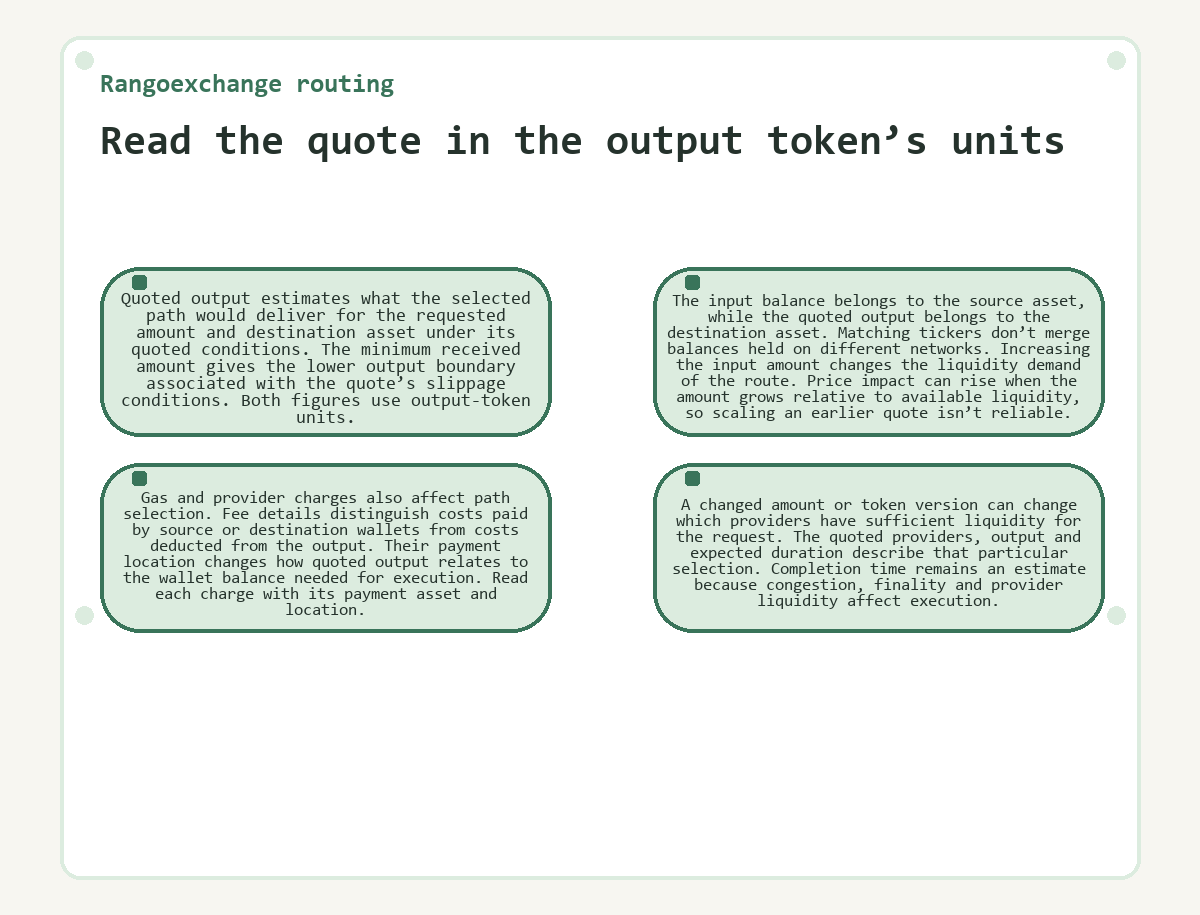
Gas and provider charges also affect path selection. Fee details distinguish costs paid by source or destination wallets from costs deducted from the output. Their payment location changes how quoted output relates to the wallet balance needed for execution. Read each charge with its payment asset and location.
A changed amount or token version can change which providers have sufficient liquidity for the request. The quoted providers, output and expected duration describe that particular selection. Completion time remains an estimate because congestion, finality and provider liquidity affect execution.
Keep the recipient on the requested destination network
The recipient address must be compatible with the destination network, and the output asset must suit the receiving wallet or application. Compare the recipient address and, for a contract token, its contract identifier with the route preview before authorizing execution. Don’t sign a request with identifiers that differ from the intended path. Route preparation and wallet authorization are distinct from delivery. The destination transaction status and receiving account’s asset balance help confirm whether output arrived.
What does an empty route response mean?
A response without route data means that no usable path was returned for that request’s assets, amount and routing conditions. A missing path doesn’t prove that the token pair is permanently unsupported. A provider or liquidity constraint can prevent a path from forming. A processing-limit warning means the server took too long to find a route; an error reports a problem during the request. The response’s status and diagnostic messages help distinguish these cases. Token identity, source network and input amount remain relevant because the search applies to those specific choices.
An amount-limit warning concerns the requested amount. Returned restrictions may apply to the route’s input or, in a multistep route, to a provider step’s input asset. Changing the requested amount leaves the selected source and destination token identities unchanged.
Routing limits inside an integrated swap service
An application’s routing configuration can restrict the providers, blockchains and transaction types that the Main API considers for its requests. Such filters change the eligible paths even when the selected endpoint tokens remain identical. A path offered through another integration may fall outside the current application’s allowed set. The returned path must fit both provider support and the interface’s execution requirements.
The Basic API returns single-step routes, including supported EVM paths that combine a source swap, bridge and destination swap in one user-initiated swap transaction. The Main API also supports multistep routing. Restricting path length can remove longer alternatives. Supporting a network in a token selector doesn’t establish support for every path that includes it.
A returned preview can also lack prerequisite validation. In the Main API, a null validation status can mean that prerequisite checks weren’t requested. It doesn’t show whether the wallet holds the required input and fee assets. When the user confirms the route, checkPrerequisites must be set to true; otherwise, the Main API won’t create the transaction.
Rangoexchange routing: questions and answers
Does reversing a token pair preserve the same routing path?
Reversing a token pair creates a different routing request with its own provider and liquidity requirements. The previous output token and network become the source selection, and the previous input token and network become the destination. A path available in one direction doesn’t establish that the reverse direction has a compatible path. Output, fees and intermediate assets need a quote for the reversed selection.
Which token address identifies a native coin in a Rangoexchange API request?
Rangoexchange represents a native coin with its blockchain and symbol and a null token address. This distinguishes the chain’s native asset from a token identified by a contract address. A zero address or repeated-letter placeholder isn’t the native-coin identifier. Select the native asset entry for the intended blockchain; a wrapped version has its own token identity.
How does slippage tolerance affect the routes that Rangoexchange returns?
The requested slippage tolerance can exclude providers or paths that aren’t suitable for that setting. Slippage tolerance sets the permitted difference between quoted and executed output. It doesn’t create liquidity or change the identity of the destination token. A wider tolerance allows greater execution variation and doesn’t establish that the received amount will improve.
Must routing through the API include centralized providers?
Centralized providers are disabled by default in Rangoexchange’s Basic and Main APIs. A routing request can enable them explicitly. Enabling that option requires the user’s IP address for compliance checks, and a provider may hold funds for identity verification if its screening flags the wallet as risky. Those requirements belong to the enabled centralized providers.
Will a Main API best-route request need an address for an intermediate blockchain?
The Main API’s best-route request uses a selected wallet address for each blockchain involved in a multistep route. An intermediate blockchain can therefore need its own entry in the request’s wallet mapping. The mapping assigns each selected address to the relevant network. An address entry provides account information; it doesn’t prove that a swap transaction has been authorized or completed.